Business development
Upwork Business Developer
Reads the job post, decides whether it is worth bidding, and drafts the proposal
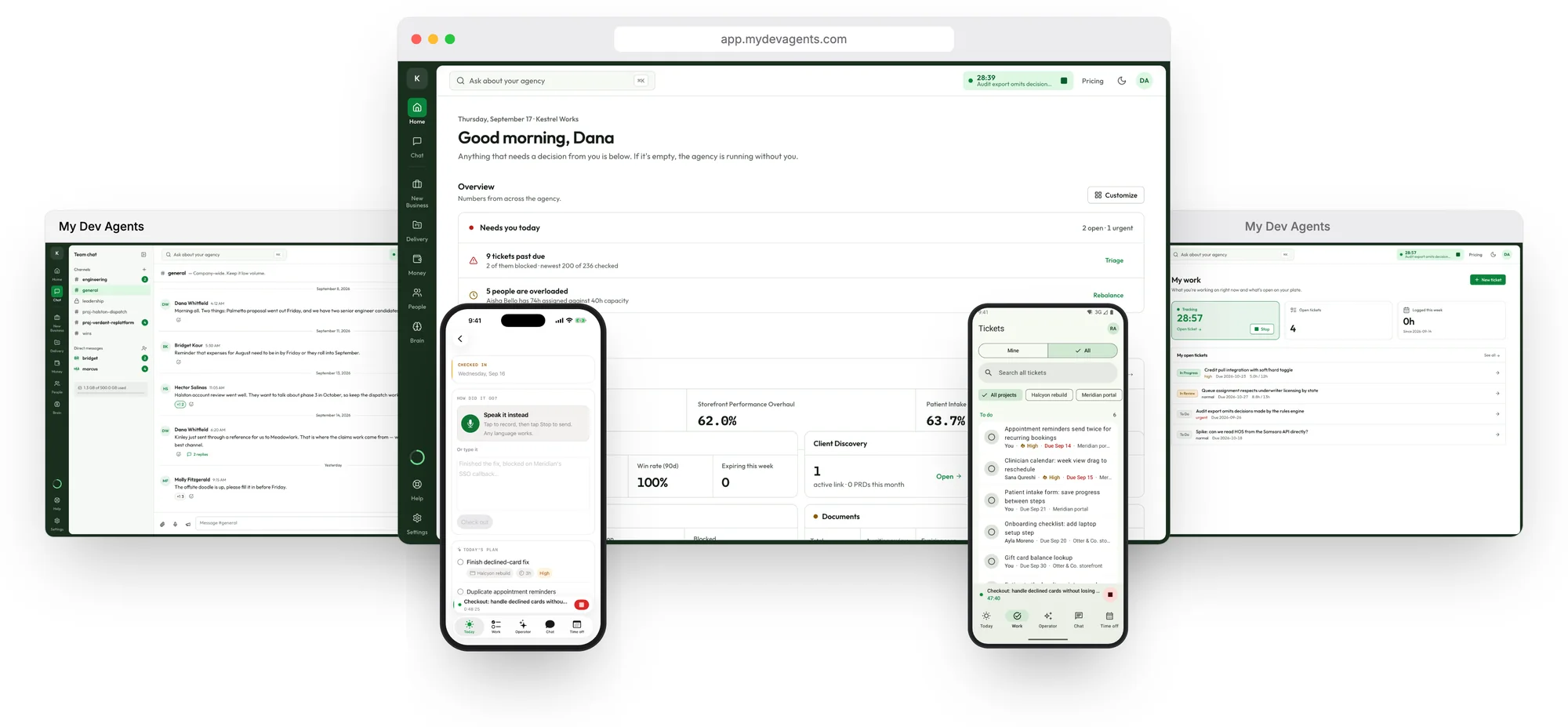
16 modules covering new business, delivery, money, people and everything your agency knows, all in one workspace, reading the same context. Your team stops re-briefing software and starts reviewing finished work.
Free plan at launch. No card, and one email, when it opens.
New Business
2Win the work
Delivery
4Scope it and ship it
Money
4Know what it earned
People
3Hire, track, review
Brain
3Everything you rely on
Shared project context: every module reads the same clients, projects, people and permissions, so nothing gets re-explained
Why an OS, not more tools
Buying an AI tool per problem means a human carries the context between them: pasting the brief in again, re-explaining the client, reconciling numbers that never agreed. On one OS the handoff is the product.
Client Discovery
A PRD draft, filled in by the client
Technical Business Analyst
A scope, a plan and acceptance criteria
Projects & Time
Sprints, assignments and logged hours
Accounting
Invoices raised against the work
Margin
What the project actually earned
One client, one thread, five modules, and a human reviewing rather than retyping at every step.
The roster
Each one owns a job somebody in your agency is currently doing by hand. You don't buy them individually, and you never pay per module.
“Which opportunities are worth our time, and what did we send them?”
“What's in flight, what's late, and what does the client already know?”
Business analyst
Turns a brief into a scope, a plan and acceptance criteria you can defend in a dispute
Delivery manager
Sprints, time and workload, with AI estimates played back against reality
QA engineer
Talk through a test session. It comes out as tickets, not a document nobody opens
Account manager
Clients see delivery, invoices and change requests without a status call
“What did we earn, what are we owed, and which work is worth repeating?”
Finance lead
Live profitability per project, worst first, with a projection of where each one lands
Data entry
Reads bank statements, payroll, invoices and timesheets, checks the arithmetic, and asks when unsure
Bookkeeper
Multi-currency income, expenses, invoices and cash flow, with voice entry
Bookkeeper
Reads payment platform exports and reconciles them against what you invoiced
“Who's on what, who's stretched, and who's due a conversation?”
“How do we do this, and where is the last one we did?”
The leverage
Growth in an agency is normally gated on senior people's hours. The OS moves the senior work from producing to reviewing, which is the only way headcount stops being the ceiling on revenue.
Function
Costs you today
On the OS
New business
A senior person's afternoon per serious brief
A qualified opportunity and a drafted proposal to review
Scoping
A week of back-and-forth before anyone can quote
A defensible scope you edit rather than author
Delivery admin
Status chasing, standup notes, client update emails
Captured as the work happens, visible to the client
Finance
A month-end scramble and a spreadsheet nobody trusts
A continuously current ledger and reports built from it
Hiring
CV piles and take-home tests you have to write
A shortlist that has already been tested and scored
Knowledge
Asking whoever has been here longest
Searchable, and reusable by every agent in the system
Margin
Utilisation is a proxy. Revenue is a proxy. The real question is whether each project earns more than it costs to deliver, and the only honest way to answer it is your own data: contract values, logged hours, and what each person's hour actually costs you.
The board sorts by margin, ascending. The project quietly eating its budget is the first thing you see, not a chart you have to interrogate.
At the current burn, each project gets a projection of where its margin lands. You find out at 40% done, while there is still something to do about it.
Every margin decomposes into where the hours went, per person, with the cost of each. Suggested cost rates come from your own compensation data, with the working shown.
A suspiciously good margin usually means missing data, so the board flags what it doesn't know on every number. If cost rates are missing, it tells you the margin is flattering rather than letting you believe it.
How Margin worksIntake
You don't migrate anything or re-key a year of history. Drop in the files your bank, payment platform and timesheets already produce (CSV, TSV, TXT and PDF) and the system reads them, checks the arithmetic, and asks about anything it isn't sure of.
The first statement from your bank teaches it the layout. Every one after that is read instantly, with no re-learning.
Opening balance plus transactions must equal closing balance. Rows that don't add up become questions, not entries.
Anything uncertain goes to a review queue, one question at a time, with the source row shown. It never guesses on money.
Payroll rows are paired with the bank debits that paid them, with the evidence shown and a confidence score on each match.
Reading never touches your books. You preview every import as a dry run first, and every import can be undone per document.
The manual path always exists. If a document confuses it, or you just don't trust it yet, type the entry in and carry on.
The operator
“Which projects are losing money?” is a question about three tools and a spreadsheet. When the whole agency runs on one system, it's a question you type once. Press Cmd-K anywhere in the app and ask in plain English.
Reading from
The platform
An OS is only useful if the whole team can be on it. Accounts, permissions, integrations and billing are designed for an agency rather than a single power user.
Margin and Accounting can require a second factor per person, enforced on the server, because cost rates and contract values are nobody's business but yours.
Owners, admins and members see different things. A member's dashboard shows their day, not your margins.
One workspace for the whole agency. Every module reads the same clients, projects and people.
Feed it the exports your bank, payment platform and timesheets already produce. No migration project required.
On the Agency plan, clients log into a portal under your brand, not ours.
A single credit allowance covers every module. No per-agent pricing, no surprise line items.
Pricing
You never pay per module. Plans differ by how many people are in the workspace and how much of the agency they cover, from proposals only on Free to the full OS on Agency.
For trying it on one real project
Put the agents to work on one real project and see what comes back. No card, no expiry.
For independent consultants and one-person shops
The new business and delivery agents at full volume. Win the work and scope it without a second pair of hands.
For agencies of 3 to 15 people
The whole agency on one system: every project, plus the finance and people agents behind them.
For established agencies running multiple teams
Everything in Studio, under your own brand, with the headroom for a full delivery organisation.
Full plan details, seat pricing and what a credit buys are on the pricing page.
FAQ
16 modules across five departments, in one workspace. New Business (opportunity qualification, proposals, client discovery), Delivery (scoping, sprints and time, QA, client portal), Money (the live margin board, document intake, multi-currency accounting, payment reconciliation), People (hiring with skill testing, daily check-ins, review cycles), and Brain (searchable agency knowledge, documents, your own reusable agents).
Point tools don't share anything, so a person becomes the integration: pasting the brief in again, re-explaining the client, reconciling numbers that never agreed. Every module here reads the same clients, projects, people and permissions, so what one produces is what the next one starts from. That shared context is also the only way a live margin number is possible at all.
You drop in the files your systems already produce: bank statements, payroll sheets, invoices and timesheets, as CSV, TSV, TXT or PDF. Intake learns each format once, checks that the arithmetic adds up, and queues anything uncertain as a question rather than guessing. Nothing is written into your books without a preview, and every import can be undone. If you'd rather type an entry in by hand, that path always exists.
Yes. Permissions are role-based, so salaries, cost rates and client financials stay scoped to the people who should see them. Margin and Accounting can additionally require two-factor authentication per person, enforced on the server. A team member's dashboard shows their day, not your margins.
The board is built to be doubted. Every number carries confidence flags: if cost rates are missing, if no time has been logged, if expenses aren't linked, it says so on the number instead of presenting a flattering figure. When data is incomplete you get a margin plus a named reason to distrust it, which is more useful than a confident wrong answer.
Yes, and it's free forever rather than a trial. The free plan covers proposals and one live project, with no card required.
The OS is in development with a launch planned once the whole system meets the bar we've set for it. Joining the waitlist gets you early access in order of signup, and launch pricing locked at the numbers on this page.
16 modules, one workspace, one subscription. Your team reviews the work instead of producing all of it.
Free plan at launch. No card, and one email, when it opens.